Vertical vs Horizontal Cardboard Balers
Cardboard waste is one of the largest recyclable waste streams generated by warehouses, retailers, manufacturers, logistics companies, supermarkets, and distribution centres. While recycling cardboard helps businesses reduce landfill waste, improve sustainability, and lower disposal costs, the efficiency of the process often depends on choosing the right cardboard baler. For many businesses, the biggest question isn’t whether they need a cardboard baler, it’s whether a vertical cardboard baler or a horizontal cardboard baler is the better investment.
Although both machines compress cardboard into dense, manageable bales, they are designed for different waste volumes, operational requirements, available space, and business goals. Selecting the wrong equipment can result in unnecessary labour, increased operating costs, and limited productivity.
This guide compares vertical vs horizontal cardboard balers, explains where each solution performs best, and highlights the key factors businesses should evaluate before making an investment.
What Is a Cardboard Baler?
A cardboard baler is a recycling machine that compresses loose cardboard into compact bales that are easier to store, transport, and recycle. By reducing the volume of cardboard waste, businesses can improve waste handling, create safer workspaces, reduce collection frequency, and potentially lower waste management costs.
Cardboard balers are commonly used in:
Warehouses
Manufacturing facilities
Retail stores
Distribution centres
Shopping centres
Supermarkets
Recycling facilities
Logistics companies
The two most common types are vertical cardboard balers and horizontal cardboard balers. While they perform the same core function, they differ significantly in capacity, operation, automation, and suitability for different industries.
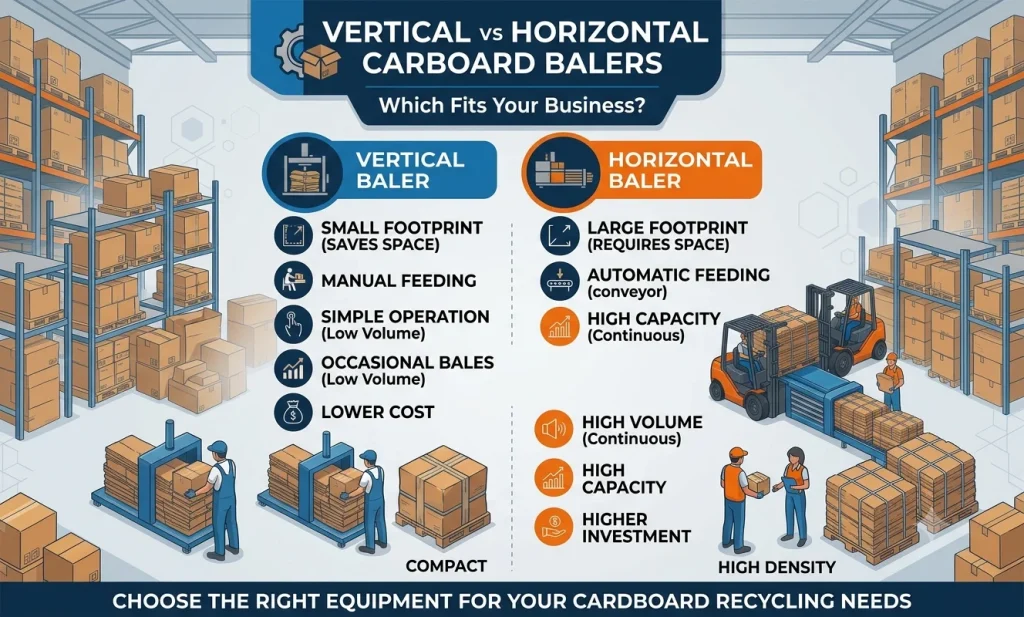
Vertical vs Horizontal Cardboard Balers at a Glance
| Feature | Vertical Cardboard Baler | Horizontal Cardboard Baler |
| Waste Volume | Low to Medium | High to Very High |
| Loading Method | Manual | Conveyor or Automatic |
| Floor Space | Compact | Larger footprint |
| Labour Requirement | Moderate | Lower |
| Automation | Semi-automatic | Highly automated |
| Bale Size | Smaller | Larger and denser |
| Initial Investment | Lower | Higher |
| Best For | Retail, Warehouses, Small Manufacturers | Distribution Centres, Recycling Facilities, Large Manufacturers |
Both options improve recycling efficiency, but the right choice depends on your operational needs rather than simply choosing the larger machine.
Understanding Vertical Cardboard Balers
A vertical cardboard baler compresses waste from top to bottom using a hydraulic ram. Operators manually load cardboard into the chamber before starting the compression cycle. Once enough material has been compacted, the finished bale is tied and removed for recycling.
These machines are popular because they require minimal floor space and are suitable for businesses producing moderate amounts of cardboard waste.
Advantages of Vertical Cardboard Balers
Smaller footprint for limited spaces
Lower upfront investment
Easy operation and maintenance
Reduced waste storage requirements
Improved workplace organisation
Suitable for multiple recyclable materials, including cardboard and some plastics
Vertical balers are particularly effective for businesses that generate regular but manageable volumes of packaging waste throughout the day.
Understanding Horizontal Cardboard Balers
A horizontal cardboard baler is designed for organisations handling significantly larger waste volumes. Instead of relying on manual loading, many horizontal balers integrate with conveyors or automated feeding systems, enabling continuous operation with minimal interruption. Because these systems process material much faster, they are commonly installed in facilities where waste is generated continuously during production or distribution.
Horizontal cardboard balers are often selected by:
Large warehouses
Manufacturing plants
Recycling centres
Distribution hubs
High-volume logistics operations
Their ability to produce larger, denser bales improves transportation efficiency while reducing manual handling.
Key Differences Between Vertical and Horizontal Cardboard Balers
1. Waste Processing Capacity
The most significant difference is processing volume.
Businesses producing occasional cardboard waste rarely require the throughput of a horizontal baler. However, facilities generating several tonnes of cardboard daily may quickly outgrow a vertical machine. If employees regularly wait for the baler to become available or cardboard accumulates around loading areas, upgrading to a horizontal system may improve operational efficiency.
2. Available Floor Space
A vertical cardboard baler occupies considerably less space, making it suitable for retail stockrooms, compact warehouses, and smaller industrial facilities. Horizontal balers require additional space for:
Conveyor systems
Bale storage
Material loading
Operator access
Maintenance activities
Businesses should evaluate future growth alongside current space availability before making a purchasing decision.
3. Labour Requirements
Vertical balers involve more manual handling. Employees load cardboard manually, initiate each compression cycle, and remove completed bales. Horizontal balers automate much of this process, reducing operator involvement and supporting continuous waste handling during busy operations. For businesses experiencing labour shortages or increasing waste volumes, automation may provide long-term productivity benefits.
4. Investment vs Long-Term Value
Vertical cardboard balers generally involve a lower initial investment, making them attractive for businesses beginning their recycling journey. Horizontal systems require a higher upfront investment but often deliver greater long-term value through:
Reduced labour costs
Increased productivity
Faster waste processing
Improved recycling efficiency
Lower transport costs due to denser bales
Rather than focusing solely on purchase price, businesses should consider the total cost of ownership over the equipment’s expected lifespan.
Maintenance and Operating Costs
Regardless of which cardboard baler you choose, routine maintenance plays a vital role in ensuring reliable performance, operator safety, and equipment longevity. Preventive servicing can minimise unexpected downtime and help businesses maintain consistent recycling operations. For vertical cardboard balers, maintenance is generally straightforward and may include:
Inspecting hydraulic systems for leaks
Checking and replacing worn baling wires or straps
Cleaning the chamber to prevent material build-up
Lubricating moving components
Testing safety interlocks and emergency stops
Horizontal cardboard balers often require more comprehensive servicing due to their higher throughput and additional automation. Regular inspections of conveyors, sensors, hydraulic components, and control systems are essential to keep production running efficiently.
The right maintenance schedule depends on usage, operating conditions, and the manufacturer’s recommendations. Businesses should also ensure operators receive proper training to maximise equipment performance and reduce avoidable wear.
Which Cardboard Baler Is Best for Your Industry?
Different industries generate different volumes and types of cardboard waste. Choosing the right baler starts with understanding your operational needs rather than selecting the largest machine available.
| Industry | Recommended Solution |
| Retail Stores | Vertical Cardboard Baler |
| Supermarkets | Vertical or Horizontal (depending on volume) |
| Warehouses | Vertical for moderate volumes, Horizontal for high throughput |
| Manufacturing | Horizontal Cardboard Baler |
| Distribution Centres | Horizontal Cardboard Baler |
| Logistics Companies | Horizontal Cardboard Baler |
| Recycling Facilities | Horizontal Cardboard Baler |
For growing businesses, it’s also worth considering future expansion. Investing in equipment that can accommodate increasing waste volumes may reduce the need for an earlier upgrade.
Common Mistakes When Buying a Cardboard Baler
Purchasing a cardboard baler is a long-term investment, and several common mistakes can lead to unnecessary costs or operational inefficiencies.
1 Choosing Based on Purchase Price Alone
A lower upfront cost doesn’t always deliver the best long-term value. Consider labour savings, productivity improvements, maintenance, and waste collection costs over the life of the equipment.
2 Underestimating Waste Volumes
Many businesses purchase equipment based on their current waste output without considering future growth. If cardboard generation increases, the baler may no longer meet operational requirements.
3 Ignoring Available Space
It’s important to assess not only where the baler will be installed but also the space required for loading, bale removal, storage, and routine servicing.
4 Overlooking Operator Training
Even the most advanced recycling equipment performs best when operators understand correct loading procedures, safety practices, and routine inspections.
5 Not Considering Service and Support
Reliable after-sales support, preventive maintenance, and access to spare parts are just as important as the equipment itself.
Expert Tips Before Investing in a Cardboard Baler
Before making a decision, ask the following questions:
How much cardboard waste do we generate each day or week?
Is waste volume likely to increase over the next three to five years?
Do we have enough space for installation and safe operation?
Would automation improve productivity?
How many staff currently handle cardboard waste?
Can the equipment integrate with our existing recycling processes?
What level of servicing and technical support is available?
Taking the time to answer these questions will help businesses choose a solution that supports both current operations and future growth.
Making the Right Choice
There isn’t a single “best” cardboard baler for every business. The right choice depends on factors such as waste volume, available space, labour availability, operational goals, and long-term recycling strategy. A vertical cardboard baler is often the preferred option for businesses with moderate waste volumes, limited floor space, and lower capital budgets. A horizontal cardboard baler is generally better suited to organisations handling continuous, high-volume cardboard waste where automation, productivity, and operational efficiency are priorities.
Evaluating these factors carefully will help ensure your investment delivers measurable improvements in waste handling, recycling efficiency, and overall operational performance.
Ready to Improve Your Cardboard Recycling Process?
Choosing the right cardboard baler is more than selecting a machine—it’s about improving efficiency, reducing waste management costs, and creating a safer, more organised workplace. Whether you’re upgrading existing recycling equipment or investing in your first cardboard baler, Smart Waste Solutions can help you identify the most suitable option for your operational requirements, waste volumes, and available space.
Contact Smart Waste Solutions today to discuss your recycling goals and discover a cardboard baler solution designed to support your business now and into the future.
Frequently Asked Questions for Vertical vs Horizontal Cardboard Balers Compared
A vertical cardboard baler is typically manually loaded and suited to low-to-medium waste volumes, while a horizontal cardboard baler is designed for higher throughput and often supports automated feeding systems.
Most small businesses, retailers, and offices benefit from a vertical cardboard baler because it requires less space, has a lower upfront cost, and effectively handles moderate amounts of cardboard waste.
For businesses generating large volumes of cardboard, a horizontal cardboard baler can improve productivity, reduce manual handling, and lower long-term waste management costs through greater automation and larger bale sizes.
The required space depends on the equipment model. Vertical balers generally have a compact footprint, while horizontal balers require additional room for conveyors, bale storage, and maintenance access.
Many cardboard balers can compact certain types of plastic packaging as well as cardboard. Businesses should confirm material compatibility with the equipment specifications before purchase.
Servicing frequency depends on usage and manufacturer recommendations. Regular inspections, cleaning, and preventive maintenance help improve reliability and extend equipment life.
Consider your waste volume, available floor space, labour requirements, budget, future growth plans, and recycling goals. Consulting an experienced equipment provider can help you select the most appropriate solution.
Yes. By compressing cardboard into dense, recyclable bales, businesses can reduce storage space, improve recycling efficiency, lower collection frequency, and potentially decrease waste disposal costs.